UP IN SMOKE: WHAT WE CAN LEARN FROM VW

 Most Australian fleet managers and drivers for that matter can give you a pretty comprehensive run-down of their vehicles’ safety features, engine power stats, transmissions, GVMs, even tare weights.
Very few though can wax lyrical on the amount of NOx (oxides of nitrogen) emitted by individual models in their fleet, not to mention nasties like the highly toxic Carbon Monoxide.
Of course, that’s not to say fleet managers or their drivers are careless, it’s understandably something that’s not on everyone’s radar in and amongst the fray of managing a vast or even a small transport fleet.
Most Australian fleet managers and drivers for that matter can give you a pretty comprehensive run-down of their vehicles’ safety features, engine power stats, transmissions, GVMs, even tare weights.
Very few though can wax lyrical on the amount of NOx (oxides of nitrogen) emitted by individual models in their fleet, not to mention nasties like the highly toxic Carbon Monoxide.
Of course, that’s not to say fleet managers or their drivers are careless, it’s understandably something that’s not on everyone’s radar in and amongst the fray of managing a vast or even a small transport fleet.
The VW effect
Unless you’ve been living under a very large rock, you couldn’t have missed the recent international media surrounding Volkswagen and the falsifying of emissions tests in the United States. Essentially, VW had developed software that meant an engine could detect an emissions test, and enter a “temperature conditioning” mode that limited the output of NOx, when the engine believed the test was over the engine reverted to its original emission output. This means since 2009, the tests reflected results that simply couldn’t be achieved in ‘real-world’ driving situations. Aside from trust now lost in a respected brand that’s been a staple around the world for many decades, VW’s practices have certainly cost them significantly. VW are now facing massive fines, lawsuits and a plummeting share price. The final price of which is still unknown. Here in Australia, some 91,000 models are said to be affected, including 14,000 Audi models, the fallout of which has yet to be fully felt. It remains to be seen if a recall (likely to get underway in 2017) will get full take-up or not, and then there’s the issue of compensation – all questions left for VW to ponder.So what’s so important about road transport emissions?
You can’t see them, but particulate matter emissions do have an effect on our health and now (more than ever before), their ongoing management has morphed into a massive issue for car and truck manufacturers around the world. It’s not something we can ignore. Australia is consistently ranked among the worst in the world for carbon emissions and is home to a disproportionately high rate of Carbon Dioxide emissions per capita.The impacts
According to the Australian Government, particulate matter (PM) emissions contribute to existing respiratory and cardiovascular conditions and can be directly linked to some cancers. The Global Burden of Disease (GBD) is a ranking used to help develop health policy around the world and in a recent comparative study of 67 health risk factors – ambient PM pollution came in at number nine just behind smoking and alcohol abuse. So the health impacts of PM are definitely real, that’s why, in the Australian truck industry at least, manufacturers are held to robust Euro 5 standards laid down by the Truck Industry Council. In fact, it would take sixty of today’s Euro 5 trucks to equal the exhaust e4mission levels of just one pre 1995 model. But whilst engine efficiency and emissions reduction are at the heart of Euro standards, they remain at the very cusp of what’s possible in an engineering sense, making adherence more and more difficult to attain.Diesel’s not the bad guy
We shouldn’t ‘shoot the messenger’ in the wake of the VW fiasco either. The issue isn’t so much the fuel source itself, which is where the debate is rapidly heading, more so it’s the responsible and transparent management of that fuel source – regardless of its application. For the time being diesel is here to stay, and for the foreseeable future too. Like it or not, there simply isn’t an economically viable (in a refining sense), widely available alternative on the horizon just yet. Alternative fuels and their emissions, such as compressed natural gas (CNG), are gentler on health and the environment, but they’re expensive to extract, refine and distribute. Meanwhile, the modern world still requires transport, energy and commerce.One for the road
There are vast differences between ‘real world’ and lab testing when it comes to emissions results and the claims of car and truck makers on the showroom floor. In light of the worldwide response to the VW scandal, it looks certain the push for greater transparency around regulations and reporting is only to going increase in the years to come. For manufacturers this will mean demonstrating strong leadership in the areas of transparency, and keeping our vehicles viable long-term participants of the greater road network.Food for thought
The average age of trucks and cars on Australian roads is far older than places like Europe and the US making the fleet far ‘dirtier’ too. If you were thinking about an upgrade, it’s probably time – especially if you’re truck or car is pre 1995.- Current Australian truck emission standards sit at Euro 5 (ADR 80/03). This took effect in January 2011. Cars on the other hand aren’t required to adhere to Euro 5 standards until 2016-17. You do the math.
- This all means manufacturers, particularly foreign car makers, can dump non Euro 5 model cars here in Australia. This of course drives up the overall pollution level per capita.
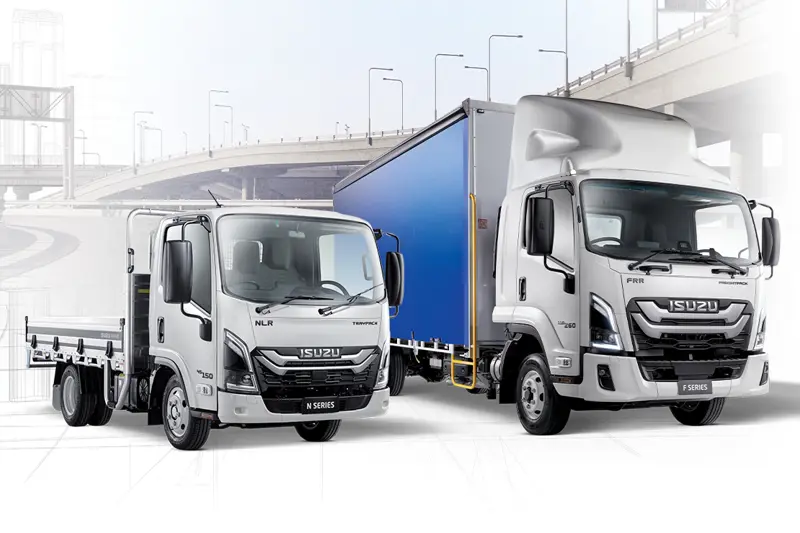
Reliability redefined.
The all-new range of Isuzu trucks has arrived. With a sleek new cab design, more advanced safety features and a smoother, more comfortable drive, the new range will change the way we rely on our trucks. Forever.
Learn more

Subscribe
Want all the latest Isuzu news?
Stay up to date with the latest on Isuzu and dealerships near you.