LOCALISING IMPORTED TRUCKS FOR DOWN UNDER

Australia’s conditions are harsh, unpredictable and unforgiving. We see it all from arid and dry desert-like conditions, to tropical humidity and numbingly cold winters—and that’s not even mentioning the dust storms and high winds. Driving in uniquely Australian conditions calls for more than a cookie-cutter truck that’s designed to be used in Europe or Asia. After all, Australia is the largest island (or smallest continent) in the world… there’s no other place quite like here.
Australian drivers need trucks specifically suited to not only our weather and conditions, but also tailored to the applications here—be it for freight and distribution across our country’s vast, unforgiving expanse, or for quarry and construction work.
Despite these needs in our unique market, we’d be hard-pressed to find imported trucks that have been localised with our working conditions in mind. Many original equipment manufacturers (OEMs) fill the market with fully imported trucks, creating a ‘take it or leave it’ situation where truck drivers scramble to find the next best fit for Australian applications.
Where does this leave us? Sometimes drivers are forced to modify their trucks themselves, leading to DIY adjustments that can be dangerous, such as non-compliant bullbars.
Can Australian drivers survive using overseas products? Yes, we can. But product localisation allows us access to equipment better suited for our needs. And knowing our truck’s specifically designed for Australian conditions and applications—with locally tailored efficiencies, translating to a better bottom line—who wouldn’t rest easier?
Let’s have a look at a few localised truck customisations that have made our work (and lives!) that bit easier.
 Ready-to-work, ready to go
Before we dive into the different truck localisations present in different Australian industries, what’s worth noting is the pre-bodied, ready-to-work truck developed right here in Australia—revolutionising the way we acquire trucks, the way we think about buying trucks.
Before the introduction of the ready-to-work truck, truck buyers have had to wait for the chassis they’ve bought to be fitted with a body for their business’s needs. A couple of drawbacks spring to mind: time spent waiting, and extra time and effort spent on locking down truck body design and customisation.
And with our local pre-bodied trucks, they come in trade-specific configurations, featuring tippers and curtain-siders among others. This localised innovation is surely one to love.
Ready-to-work, ready to go
Before we dive into the different truck localisations present in different Australian industries, what’s worth noting is the pre-bodied, ready-to-work truck developed right here in Australia—revolutionising the way we acquire trucks, the way we think about buying trucks.
Before the introduction of the ready-to-work truck, truck buyers have had to wait for the chassis they’ve bought to be fitted with a body for their business’s needs. A couple of drawbacks spring to mind: time spent waiting, and extra time and effort spent on locking down truck body design and customisation.
And with our local pre-bodied trucks, they come in trade-specific configurations, featuring tippers and curtain-siders among others. This localised innovation is surely one to love.
 Construction
One of the more popular truck localisations at the moment is attached to agitator trucks. Some are locally engineered to employ clever load-sharing solutions like shared suspensions to achieve greater GVM allowances and, hence, increased payload capacity. Additionally, these trucks can be fitted with a vertical exhaust stack to avoid situations where drivers and workers are directly breathing in exhaust fumes.
Construction
One of the more popular truck localisations at the moment is attached to agitator trucks. Some are locally engineered to employ clever load-sharing solutions like shared suspensions to achieve greater GVM allowances and, hence, increased payload capacity. Additionally, these trucks can be fitted with a vertical exhaust stack to avoid situations where drivers and workers are directly breathing in exhaust fumes.
 Emergency services
There’s been more smaller trucks receiving the 4x4 treatment for off-road Australian bush conditions, especially for applications in emergency services. This localisation allows emergency services to get to hard-to-reach areas, such as allowing our firefighters and their equipment to get to raging bushfires more easily.
And in addition to 4x4 trucks for the emergency services, localised development of these trucks has seen the adoption of two-pedal transmission, such as automated manual transmission, allowing for driver versatility—especially important in emergency sectors with volunteer drivers.
Emergency services
There’s been more smaller trucks receiving the 4x4 treatment for off-road Australian bush conditions, especially for applications in emergency services. This localisation allows emergency services to get to hard-to-reach areas, such as allowing our firefighters and their equipment to get to raging bushfires more easily.
And in addition to 4x4 trucks for the emergency services, localised development of these trucks has seen the adoption of two-pedal transmission, such as automated manual transmission, allowing for driver versatility—especially important in emergency sectors with volunteer drivers.
 Waste and recycling
More and more dual control trucks are also coming into the market to satisfy the ever-increasing transport demand in the waste and recycling industry. Dual control allows drivers to control the truck from both sides, permitting the user to switch over control to either left- or right-hand drive, whichever is safer and easier for the job at hand.
And with some dual control trucks that have been customised for and factory-assembled in Australia, there are perks in the form of locally targeted safety features, such as yellow-painted safety grab handles, steps and ladders; engine customisations to suit the rigours of such a stop-start application; decreased tare weight to handle the scale of waste and recycling collection here.
The importance of localisation
There are plenty of overseas trucks that cover the basics, but there’s a high demand and low supply of OEMs localising their imported trucks to suit the market they’re selling into.
Different markets require different products and the Australian market requires a different product from its European or Asian counterparts. The few companies who do localise their imported products realise the need to meet and understand each customer and the demands of their local applications.
And besides meeting the demands of local applications in our demanding landscape, localised trucks are more than likely to be more efficient—since they’re better suited to our environment and applications—which saves us time and money.
To top it off, by localising their products, OEMs show they value their customers, no matter what country it is, building themselves a global, yet engaged, brand.
Like country-specific truck localisations, different industries and applications also have their very own type of truck customisations, such as in the waste and recycling industry.
Waste and recycling
More and more dual control trucks are also coming into the market to satisfy the ever-increasing transport demand in the waste and recycling industry. Dual control allows drivers to control the truck from both sides, permitting the user to switch over control to either left- or right-hand drive, whichever is safer and easier for the job at hand.
And with some dual control trucks that have been customised for and factory-assembled in Australia, there are perks in the form of locally targeted safety features, such as yellow-painted safety grab handles, steps and ladders; engine customisations to suit the rigours of such a stop-start application; decreased tare weight to handle the scale of waste and recycling collection here.
The importance of localisation
There are plenty of overseas trucks that cover the basics, but there’s a high demand and low supply of OEMs localising their imported trucks to suit the market they’re selling into.
Different markets require different products and the Australian market requires a different product from its European or Asian counterparts. The few companies who do localise their imported products realise the need to meet and understand each customer and the demands of their local applications.
And besides meeting the demands of local applications in our demanding landscape, localised trucks are more than likely to be more efficient—since they’re better suited to our environment and applications—which saves us time and money.
To top it off, by localising their products, OEMs show they value their customers, no matter what country it is, building themselves a global, yet engaged, brand.
Like country-specific truck localisations, different industries and applications also have their very own type of truck customisations, such as in the waste and recycling industry.

Ready-to-work, ready to go
Before we dive into the different truck localisations present in different Australian industries, what’s worth noting is the pre-bodied, ready-to-work truck developed right here in Australia—revolutionising the way we acquire trucks, the way we think about buying trucks.
Before the introduction of the ready-to-work truck, truck buyers have had to wait for the chassis they’ve bought to be fitted with a body for their business’s needs. A couple of drawbacks spring to mind: time spent waiting, and extra time and effort spent on locking down truck body design and customisation.
And with our local pre-bodied trucks, they come in trade-specific configurations, featuring tippers and curtain-siders among others. This localised innovation is surely one to love.
Construction
One of the more popular truck localisations at the moment is attached to agitator trucks. Some are locally engineered to employ clever load-sharing solutions like shared suspensions to achieve greater GVM allowances and, hence, increased payload capacity. Additionally, these trucks can be fitted with a vertical exhaust stack to avoid situations where drivers and workers are directly breathing in exhaust fumes.
Emergency services
There’s been more smaller trucks receiving the 4x4 treatment for off-road Australian bush conditions, especially for applications in emergency services. This localisation allows emergency services to get to hard-to-reach areas, such as allowing our firefighters and their equipment to get to raging bushfires more easily.
And in addition to 4x4 trucks for the emergency services, localised development of these trucks has seen the adoption of two-pedal transmission, such as automated manual transmission, allowing for driver versatility—especially important in emergency sectors with volunteer drivers.
Waste and recycling
More and more dual control trucks are also coming into the market to satisfy the ever-increasing transport demand in the waste and recycling industry. Dual control allows drivers to control the truck from both sides, permitting the user to switch over control to either left- or right-hand drive, whichever is safer and easier for the job at hand.
And with some dual control trucks that have been customised for and factory-assembled in Australia, there are perks in the form of locally targeted safety features, such as yellow-painted safety grab handles, steps and ladders; engine customisations to suit the rigours of such a stop-start application; decreased tare weight to handle the scale of waste and recycling collection here.
The importance of localisation
There are plenty of overseas trucks that cover the basics, but there’s a high demand and low supply of OEMs localising their imported trucks to suit the market they’re selling into.
Different markets require different products and the Australian market requires a different product from its European or Asian counterparts. The few companies who do localise their imported products realise the need to meet and understand each customer and the demands of their local applications.
And besides meeting the demands of local applications in our demanding landscape, localised trucks are more than likely to be more efficient—since they’re better suited to our environment and applications—which saves us time and money.
To top it off, by localising their products, OEMs show they value their customers, no matter what country it is, building themselves a global, yet engaged, brand.
Like country-specific truck localisations, different industries and applications also have their very own type of truck customisations, such as in the waste and recycling industry.
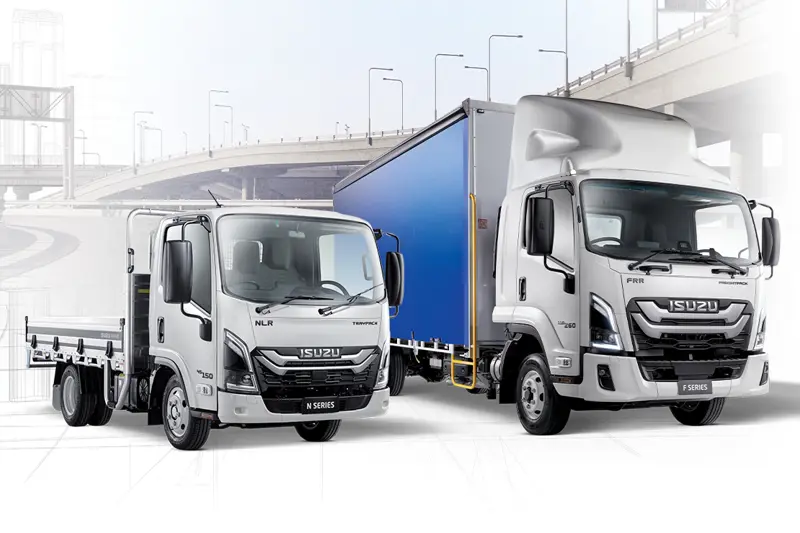
Reliability redefined.
The all-new range of Isuzu trucks has arrived. With a sleek new cab design, more advanced safety features and a smoother, more comfortable drive, the new range will change the way we rely on our trucks. Forever.
Learn more
Subscribe
Want all the latest Isuzu news?
Stay up to date with the latest on Isuzu and dealerships near you.